Manage Layers
/app/rock-physics/manage-layers
Build the layered earth model for a project: create layers, give each its measured elastic properties, and record the in-situ porosity, mineral and fluid conditions that later rock-physics modelling starts from. These layer properties are the baseline that Rock Physics Modelling turns into scenarios, and that Reflectivity, Convolution and Wave Modelling fall back on for any layer without one.
These petrophysical inputs are recorded with the layer for reference and are not part of a rock-physics computation until entered on the Rock Physics Modelling screen.
Basic layer values
The measured elastic properties of the selected layer. Press Edit to change them.

| Field | Purpose | Range | Default |
|---|---|---|---|
| Formation Name | The name of the geological formation the layer represents. It labels the layer everywhere in the app and has no effect on any calculation. | up to 50 characters letters, digits, spaces, hyphens and underscores | Reservoir |
| Vp * | Compressional wave velocity of the layer as measured in situ. It is the starting point for every rock-physics model built on this layer. | 1.5 to 8 km/s | 3.2 km/s |
| Vs * | Shear wave velocity of the layer as measured in situ. Together with the compressional velocity and density it fixes the layer's elastic moduli. | 0.01 to 5 km/s | 1.8 km/s |
| Rho * | Bulk density of the layer as measured in situ. Raising it stiffens the acoustic impedance of the layer and shifts every derived modulus. | 1 to 4 g/cm^3 | 2.35 g/cm^3 |
Limits are the API's unless marked app. The app may offer a narrower range.
* Vp: the app shows min 0; the API accepts min 1.5.
* Vs: the app shows min 0; the API accepts min 0.01.
* Rho: the app shows min 0; the API accepts min 1.
In-situ properties
Porosity and saturation of the layer at the time the elastic properties were measured.

| Field | Purpose | Range | Default |
|---|---|---|---|
| Porosity | Fraction of the rock volume that is pore space. A higher value gives the fluids more influence on the layer's stiffness and density. The value is kept on the layer in the browser session and is not sent to the API. | — | — |
| Saturation | Fraction of the pore space filled by the wetting fluid; the remainder holds the non-wetting fluid. Lowering it moves the pore fill towards the non-wetting fluid. The value is kept on the layer in the browser session and is not sent to the API. | — | — |
Limits are the API's unless marked app. The app may offer a narrower range.
Mineral properties
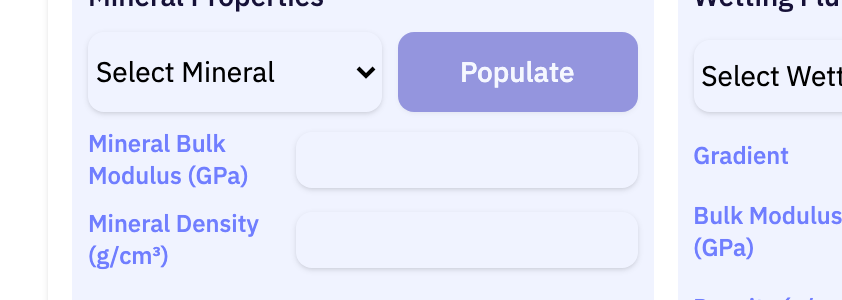
The grain material of the layer. Pick a mineral to fill in its properties, or type them directly.
| Field | Purpose | Range | Default |
|---|---|---|---|
| Porosity (ratio) | A mineral from the built-in catalogue. Pressing Populate copies its bulk modulus and density into the fields below, which you can then adjust. The value is kept on the layer in the browser session and is not sent to the API. | — | — |
| Mineral Bulk Modulus | Stiffness of the solid grains against uniform compression. It sets the upper limit that fluid substitution can push the rock towards. The value is kept on the layer in the browser session and is not sent to the API. | GPa | — |
| Mineral Density | Density of the solid grains. Combined with porosity and fluid density it gives the bulk density of the layer. The value is kept on the layer in the browser session and is not sent to the API. | g/cm³ | — |
Limits are the API's unless marked app. The app may offer a narrower range.
Wetting fluid
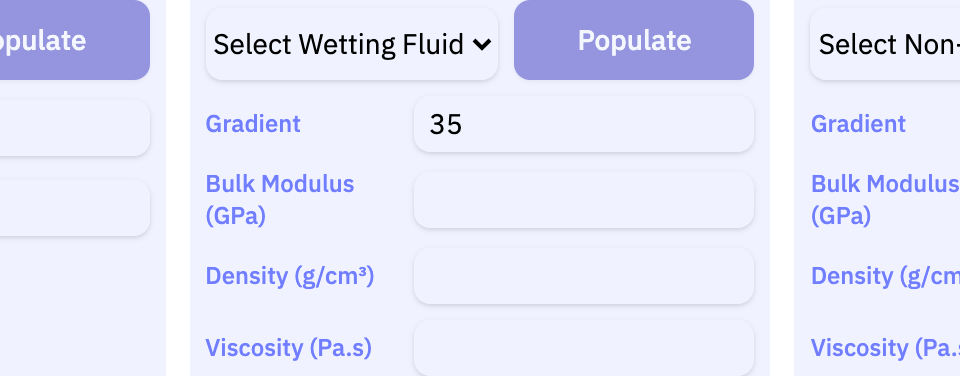
The fluid that coats the grains, typically brine. Pick a fluid and press Populate to derive its properties at the layer's depth, or type them directly.
| Field | Purpose | Range | Default |
|---|---|---|---|
| wetting-fluid-preset | A fluid from the built-in catalogue. Its properties are evaluated at the temperature and pressure implied by the layer depth and the gradient below. The value is kept on the layer in the browser session and is not sent to the API. | — | — |
| Gradient | Geothermal gradient used with the layer depth to estimate the in-situ temperature when populating the fluid properties. A steeper gradient means a warmer, less stiff fluid. The value is kept on the layer in the browser session and is not sent to the API. | °C/km | 35 °C/km |
| Bulk Modulus | Stiffness of the wetting fluid against compression. A stiffer fluid raises the compressional velocity of the saturated rock. The value is kept on the layer in the browser session and is not sent to the API. | GPa | — |
| Density | Density of the wetting fluid. It contributes to the bulk density of the layer in proportion to porosity and saturation. The value is kept on the layer in the browser session and is not sent to the API. | g/cm³ | — |
| Viscosity | Resistance of the wetting fluid to flow. It matters for models that account for fluid movement between pores and cracks and is ignored by purely elastic models. The value is kept on the layer in the browser session and is not sent to the API. | Pa.s | — |
Limits are the API's unless marked app. The app may offer a narrower range.
Non-wetting fluid
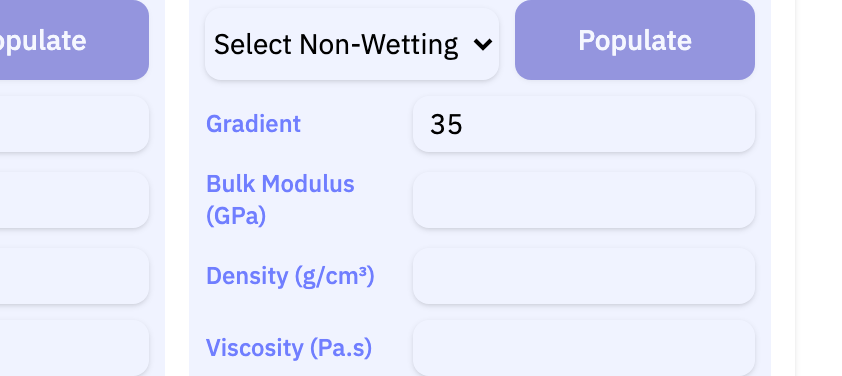
The fluid that fills the rest of the pore space, typically oil or gas. Pick a fluid and press Populate to derive its properties at the layer's depth, or type them directly.
| Field | Purpose | Range | Default |
|---|---|---|---|
| non-wetting-fluid-preset | A fluid from the built-in catalogue. Its properties are evaluated at the temperature and pressure implied by the layer depth and the gradient below. The value is kept on the layer in the browser session and is not sent to the API. | — | — |
| Gradient | Geothermal gradient used with the layer depth to estimate the in-situ temperature when populating the fluid properties. A steeper gradient means a warmer, less stiff fluid. The value is kept on the layer in the browser session and is not sent to the API. | °C/km | 35 °C/km |
| Bulk Modulus | Stiffness of the non-wetting fluid against compression. A soft fluid such as gas strongly lowers the compressional velocity as saturation moves towards it. The value is kept on the layer in the browser session and is not sent to the API. | GPa | — |
| Density | Density of the non-wetting fluid. It contributes to the bulk density of the layer in proportion to porosity and the non-wetting share of the pore space. The value is kept on the layer in the browser session and is not sent to the API. | g/cm³ | — |
| Viscosity | Resistance of the non-wetting fluid to flow. It matters for models that account for fluid movement between pores and cracks and is ignored by purely elastic models. The value is kept on the layer in the browser session and is not sent to the API. | Pa.s | — |
Limits are the API's unless marked app. The app may offer a narrower range.
Create layer
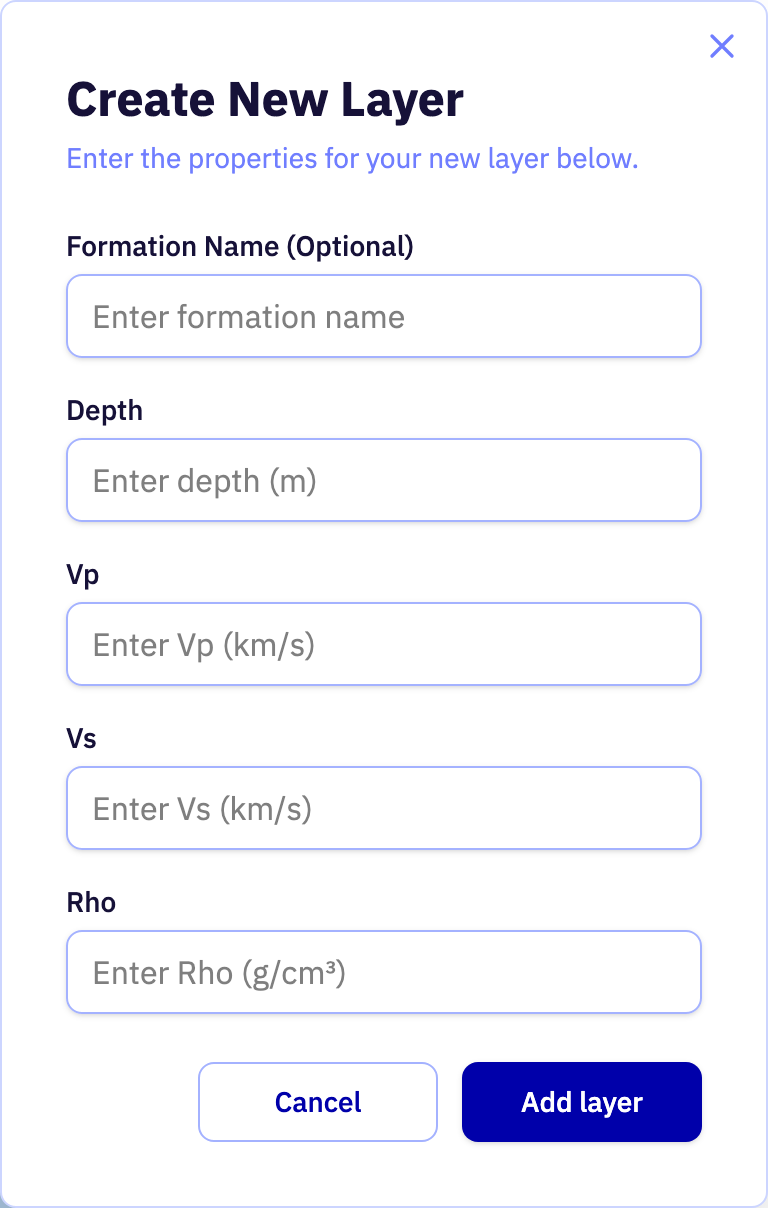
Opens from the Add Layer button. Formation name, Vp, Vs and Rho are the same fields as in Basic layer values; depth is set here and cannot be changed afterwards except by duplicating the layer to a new depth.
| Field | Purpose | Range | Default |
|---|---|---|---|
| Depth | Depth from the surface to the top of the layer. It orders the layers in the model and sets the pressure and temperature used when populating fluid properties. | 0 to 10000 m | — |
Limits are the API's unless marked app. The app may offer a narrower range.