Rock Physics Modelling
/app/rock-physics/modelling
Choose a rock-physics model for a layer, describe its mineral frame and pore fluids, compute the elastic response, and save the result as a scenario on the layer. A layer can hold several scenarios, and Reflectivity, Convolution and Wave Modelling each let you pick which scenario stands in for each layer.
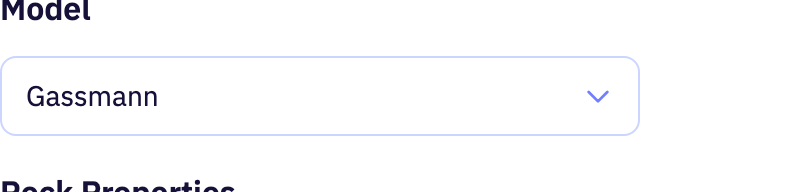
Model
Which physical model relates the rock description to its elastic response. The sections that follow change with the model.
| Field | Purpose | Range | Default |
|---|---|---|---|
| Model | The rock-physics model to run, such as fluid substitution, cracked rock, viscoelastic or squirt flow. It decides which inputs are needed and whether the result is isotropic or anisotropic. | 1 to 50 characters lowercase letters, digits, hyphens and underscores | — |
Limits are the API's unless marked app. The app may offer a narrower range.
Mineral content
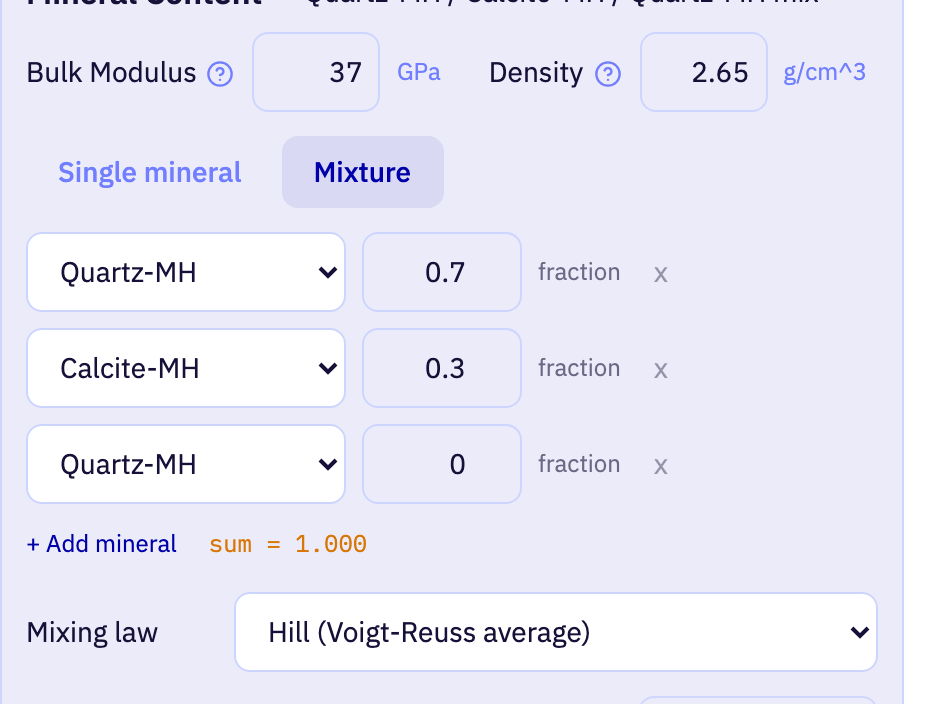
The solid grain material. Use a single mineral from the catalogue or mix several by volume fraction.
| Field | Purpose | Range | Default |
|---|---|---|---|
| Bulk Modulus | Stiffness of the solid grains against compression. It caps how stiff the rock can become as pore fluid is replaced. | over 0 GPa | 37 GPa |
| Density | Density of the solid grains. It is used when deriving the dry frame from critical porosity or grain contact theory. | over 0 g/cm^3 | 2.65 g/cm^3 |
| mineral-preset | A mineral from the built-in catalogue. Choosing one fills the grain moduli and density with its published values. | — | — |
| Mineral | One constituent of a mineral mixture, chosen from the catalogue. Each row of the mixture has its own mineral. | at least 1 character | Quartz-MH |
| Fraction * | Share of the grain volume taken by this mineral. The fractions across all rows must add up to the whole. | over 0, up to 1 | 0.7 fraction |
| Mixing law | How the moduli of the mixed minerals are averaged into one effective grain material. The Hill average sits between the upper and lower bounds; the bounds themselves give the stiffest and softest plausible mixtures. | — | Hill (Voigt-Reuss average) |
Limits are the API's unless marked app. The app may offer a narrower range.
* Fraction: the app shows unit fraction; the API accepts unit dimensionless.
Dry frame
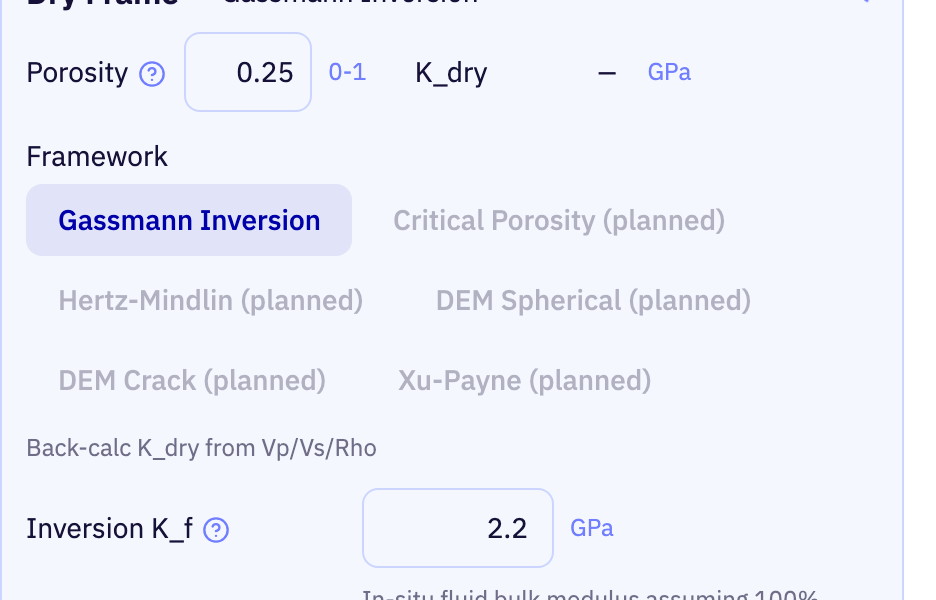
Porosity and the stiffness of the empty rock skeleton. The skeleton is derived from the layer's measured properties, from critical porosity or from grain contact theory.
| Field | Purpose | Range | Default |
|---|---|---|---|
| Porosity | Fraction of the rock volume that is pore space. Higher porosity softens the frame and gives the pore fluid more influence on velocity and density. | over 0, under 1 | 0.25 |
| Inversion K_f | Bulk modulus of the fluid that filled the pores when the layer was measured, assuming it fully saturates the rock. Used to strip that fluid out of the measured velocities and recover the dry frame; override it if the measurement-time fluid differs from the wetting fluid. | over 0 GPa | 2.2 GPa |
Limits are the API's unless marked app. The app may offer a narrower range.
Fluid content
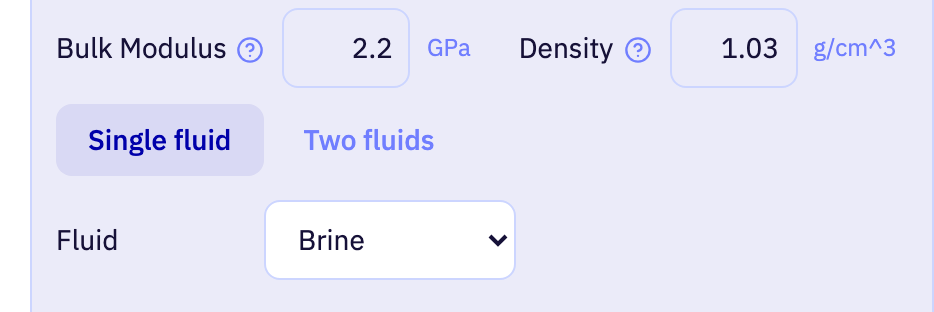
What fills the pores. A single fluid fixes the pore fill; two fluids make saturation the swept variable.
| Field | Purpose | Range | Default |
|---|---|---|---|
| Bulk Modulus | Stiffness of the pore fluid against compression. A stiffer fluid raises the compressional velocity of the saturated rock. | over 0, up to 10 GPa | 2.2 GPa |
| Density | Density of the pore fluid. It adds to the bulk density of the rock in proportion to porosity. | 0 to 2.5 g/cm^3 | 1.03 g/cm^3 |
| Fluid | A single fluid from the built-in list. Choosing one fills the bulk modulus and density above. | — | Brine |
| Wetting fluid | The fluid that coats the grains in a two-fluid pore fill, typically brine. Saturation is measured as the share of this fluid. | — | Brine |
| Non-wetting fluid | The fluid that fills the rest of the pore space in a two-fluid pore fill, typically oil or gas. A soft non-wetting fluid drives the velocity drop as saturation falls. | — | Gas |
Limits are the API's unless marked app. The app may offer a narrower range.
Rock parameters
Model-specific controls that appear only for the viscoelastic and squirt flow models.
| Field | Purpose | Range | Default |
|---|---|---|---|
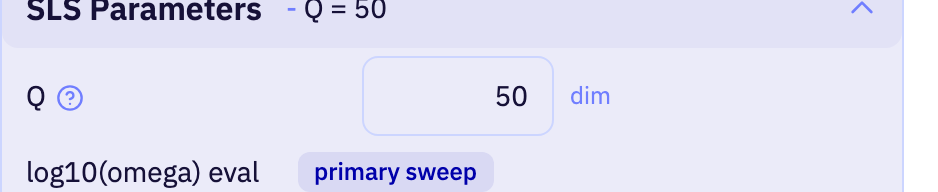
| Q * | Quality factor of the viscoelastic rock. A low value means strong attenuation and a large change in velocity with frequency; a high value approaches a purely elastic rock. | 5 to 10000 | 50 dim |
| Permeability * | How easily fluid moves through the pore network. It sets the frequency at which fluid pressure can no longer equalise between patches, moving the transition between the relaxed and unrelaxed rock. | over 0 m^2 | 0.1 D |
Limits are the API's unless marked app. The app may offer a narrower range.
* Q: the app shows unit dim; the API accepts unit dimensionless.
* Permeability: the app shows unit D; the API accepts unit m^2.
Orientation
Placement of the fracture set for the cracked rock model. Rotating it changes which directions the anisotropic result is fast and slow in.
| Field | Purpose | Range | Default |
|---|---|---|---|
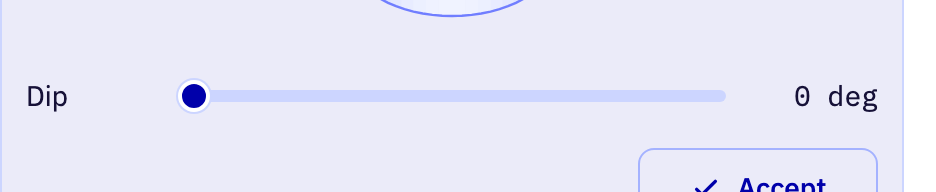
| Fracture dip | Dip of the fracture plane from horizontal. Zero leaves the fractures flat-lying; increasing it tilts the whole anisotropic response. | 0 to 90 degapp a number, with an optional minus sign and decimals | 0 deg |
| Fracture azimuth | Compass direction the dipping fracture plane faces. Only meaningful once the fractures are tilted; it rotates the response about the vertical. | 0 to 360 degapp a number, with an optional minus sign and decimals | 0 deg |
Limits are the API's unless marked app. The app may offer a narrower range.
Save scenario
Opens from Save on the results panel. The same name and notes fields appear in the Edit scenario dialog for a saved scenario.
| Field | Purpose | Range | Default |
|---|---|---|---|
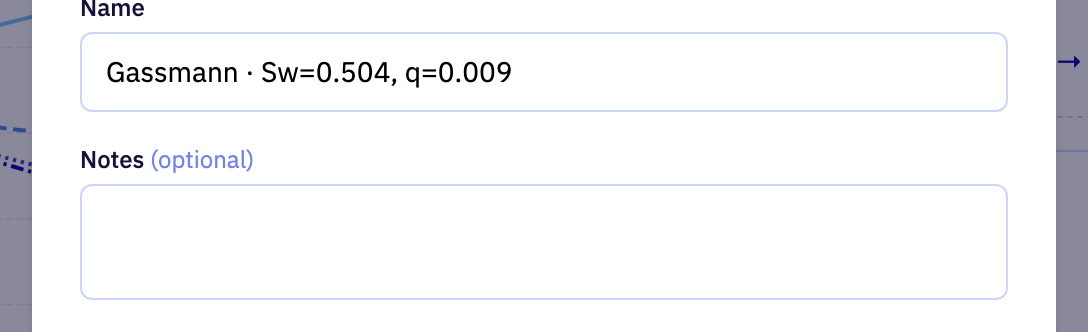
| Name | A short label for the saved scenario. It identifies the scenario in the layer's list and in downstream tools that pick a scenario. | up to 100 characters | Gassmann · Sw=0.504, q=0.009 |
| Notes (optional) | Free-text notes about the scenario, such as the assumptions behind it. Shown alongside the scenario and never used in a calculation. | up to 1000 characters | — |
| replace-target | An existing scenario of the same model on this layer to overwrite with the new result. Leave it unset to add a new scenario instead. | — | — |
Limits are the API's unless marked app. The app may offer a narrower range.